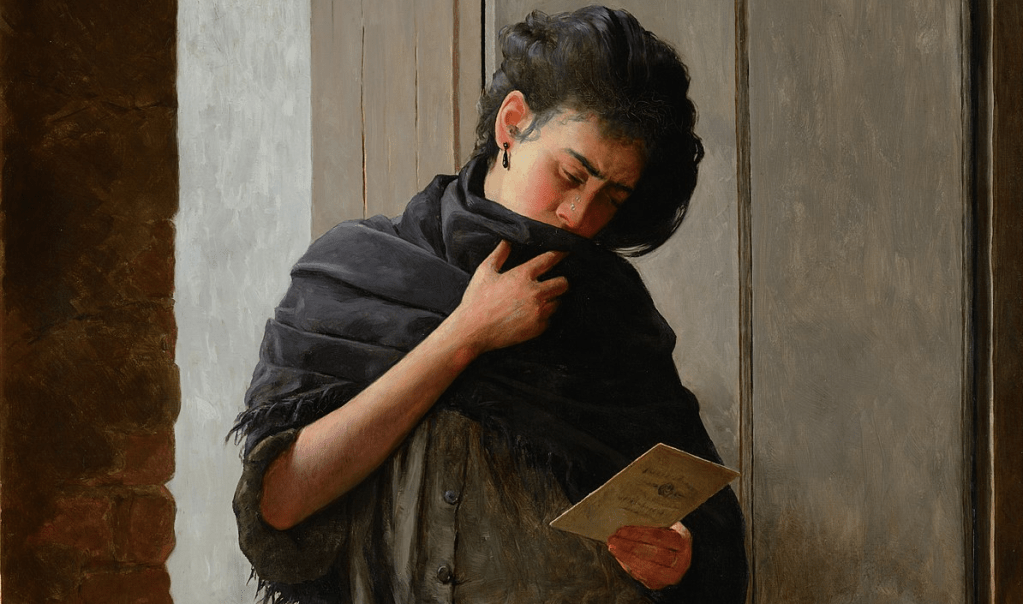
by: Theo O. (Grade 11)
Painting: Saudade (1899) by Almeida Júnior
Saudade is a word that is exclusive to the Portuguese language. No other culture, no matter how similar to us Lusophones, is able to enjoy the existence of such a term. Not the Hispanophones, not the Francophones, not the Sinophones, and, of course, not the Anglophones.
Because of this tragic – though weirdly delightful – situation, I would like to start off this article by trying to convey what the word means.
While it would be considerably more charming to drag this on and over-sophisticate an explanation, the meaning of Saudade is actually quite simple – basically, it is what you feel when you miss someone. It’s almost the noun version of the verb ‘to miss’.
The strange nature of the word – and the lack of a literal translation of it in the English language – has caught the attention of many of its distant admirers. And, in all honesty, I do believe that despite cultural differences, all dialects in the world should have a synonym of ‘Saudade‘ in their respective dictionaries – even if that meant that it would prevent it from being a point of argument when I try to convince fellow Latin friends that Portuguese is, indeed, the best Latin language of all. I’ve never had this conversation before actually, but you never know.
The truth, however, is that language belongs to no one – we belong to language. With that said, if I were to steal a word from the English language, it would definitely be ‘f*ck’. While there are a few translations of it in Portuguese, no word is able to convey the uproar and outrage that is intrinsic to this majestic term. One I would definitely not take away from you, however, would be toes. Seriously, what’s wrong with fingers? Fingers and toes are literally the same thing, but simply in different places. Sure, you could call your fingers ‘toes’, but the word ‘toes’ conveys a completely different image – it’s the opposite of ‘moist’, which is by far my favourite word in the English language. Followed by ‘windows’, bookmarks’, and ‘proposal’, in that order.
Going back from this deeply unnecessary tangent, I guess we could come up with a more palatable translation of Saudade – how does ‘missness’ sound? Or maybe “missache”, if we are taking a more melodramatic approach.
However, those horrible examples, idealised by myself, would be imprecise at expressing the feeling of Saudade. The term ‘to miss’ has a sense of ownership to it that has nothing to do with its Portuguese counterpart. As I said, language belongs to no one – and what you miss when you have Saudade doesn’t either.
When I learned to speak English, I always found the use of the verb ‘miss’ quite strange. It always felt like two things: you either lost something (which brings up unpleasant connotations of irresponsibility and incompetence), or that there is this hole or gap that was created after this thing or person left you (in my mind, this hole was always about 15cm wide and could be found on the left side of my stomach – don’t ask me why, because I have no clue). And while both ideas may seem reasonably noble and do convey this sense of romanticised melancholy – when I think of Saudade, I don’t think about losing something or having a piece of my flesh taken out of my torax.
The feeling of Saudade transcends that in a way that can hardly be described through letters or sounds (no, I will not sing for you). Instead, it feels like this beautiful and grandiose veil that looms over your body and, little by little, lowers itself, covers your face, and, somehow gently, starts to brutally suffocate you.
But fear not! This exotic ritual does not feel claustrophobia nor distress in any shape or form. It is a sentiment that oftentimes can elevate you, almost pretentiously so (hence the use of the adjective ‘grandiose’). To put it in simpler terms, when you have Saudade, you don’t only become weak – you become weak, but also kind of poetic. And while that may not serve any significant role in character building, nor will it help you gain strength in order to overcome what you are going through, it gives you some weird, baseless sense of perspective that may empower you in some way.
Unlike ‘to miss’, you have no sense of ownership over what you are feeling towards whatsoever – but you start to, somehow, own the term. After all, you don’t do Saudade, nor are Saudade – in perfect Portuguese, you have Saudade. And to have this majestic, abstract thing belonging to you, can feel liberating.
When I moved to London and started to ‘miss’ things, I never had this sensation. That is, I think, because of the fact that ‘missing something’ always gave me the idea that I once had that thing, and I had lost it. That notion saddened me – the idea that things were fine at one point, but, somehow, tables turned, and prospects abruptly changed. If you ask me, I would much rather have things go south really early on, and then I make them not as bad later.
To contextualise this thought, I would much rather see my football team lose 2-0 and score a consolation goal towards the end of the match, than to be winning 0-1 and then conceded twice. Having established the nature of the term ‘to miss’ in my mind, scoring a consolation goal would be impossible.
With Saudade, on the other hand, the way you absorb loss is a lot more independent, and possibly a lot less needy or obnoxious. I guess that is also why proportionally there are so many more songs which explicitly use the term Saudade than songs that use the terms ‘missing someone’. Sure, I imagine there are many songs with the words ‘miss’ and ‘you’ in them, and many more that revolve around the subject matter – but it is impossible to compare it to the role the word Saudade plays in Lusophone music, art, and society.
And while this is not an article advocating for Lusophone supremacy or any other delirious concept, I truly wish that I had a way to express what I feel when the feeling of Saudade hits. And while I can’t say I learned much from writing this random, undoubtedly overwritten text, one thing was well-established in my brain: I have saudade of Saudade.
 The Halcyonite
Leave a comment