Ezra ’25
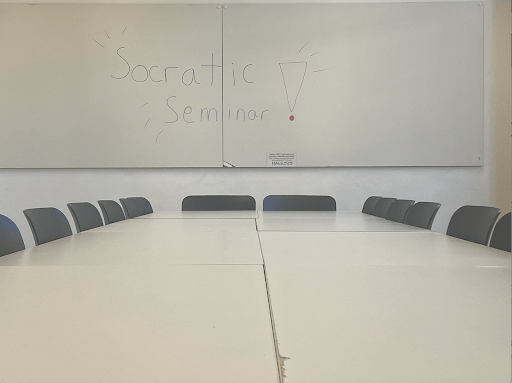
With the reintroduction of Socratic Seminars into my English class I am once again reminded of my single least favorite experience in my school day, Socratic Seminars, where silence is golden, but speaking without substance is far preferred, because sometimes you just want to talk for the sake of talking.
In an attempt to maintain open mindedness, I participated in a week-long summer program hosted by one of the world’s premier Socratic-Seminar-based colleges, St. Johns, in Santa Fe, New Mexico. The school constructs all of its classes around the Socratic Seminar model, with classes of fewer than 30 students discussing texts such as Herodotus for history, or Euclid for math. The experience offered me a chance to experience seminars facilitated at the most professional level, with name placards, honorifics, and so on. Nonetheless, my opinions on Socratic Seminars did not change after the course, and I still remain adamantly against the practice.
I will not be the first to voice my opinions regarding these seminars, and I certainly won’t be the last, therefore, I will express the many so-called “benefits” of Socratic Seminars to provide and deconstruct the counterargument.
According to Just Ask, a teacher-led publication and professional development forum, one of the key boons gained from Socratic Seminars is the ability “to be respectful of the ideas, values, and perspectives of others”. Other benefits listed by the same source are that students “actively listen and respond to their peers”, and, my personal favorite, “learn responsibility and accountability as they prepare for each Seminar”.
The latter of the listed perks finds itself in my favor due to it, by no small margin, being the weakest of the arguments. Although the idea of assigning work to be done within a deadline on a student’s timetable may be revolutionary, I find a few similarities between the concept of learning “responsibility and accountability”, and the bulk of assignments that I receive outside of Seminar-related work.
An argument that the pressure of having to live up to the expectations of not just their teachers, but their peers could be made, and one could say that therefore they are more likely to complete the work. However, in response to that argument, I would laugh at you.
I am yet to take part in a Socratic Seminar where the contributions added to more than a hastily thought-up, and easily answered questions about, for example, why the author used a certain color to describe a duck, or why they described it in the first place. A number of prophetic answers are then quickly invented to answer this question, when in reality, the author merely may have been interested in ducks.
It boils down to students believing that the system is one of quotas. I find that many of my peers believe that a short interjection that adds nothing but their agreement, comes with a grade. This is, of course, rarely the case. To quote one my of English teachers, “It’s always you versus the rubric.”
Nonetheless, the short interjections keep coming, providing nothing more than the quick formality of offering your accord, something rarely necessary in a discussion of analysis. A large percentage of the provided contributions from those students who speak most are little quips such as “I agree” and “good idea”, which add as much to the conversation as total silence, and as such, I often find myself surrounded by academic pretense, practicing the fine art of enthusiastically saying nothing.
In my case, this silence is literal, but in the case of those who partake in passionate verbose verbiage, it is metaphorical. Although I suppose something is gained from their intellectual posturing, they learn the incredibly valuable life skill of talking in circles.
Next, to take a look at the other argument presented by Just Ask; first, “Learn to be respectful of the ideas, values, and perspectives of others.” I can confidently say that my respect for my peers lowers exponentially with every useless side comment they make on the background color of a particular picture, hearing the words “so true” from three different students does little toward my respect for other perspectives.
It is difficult to find a less appealing part of my life than hearing the un-enforced opinions of others, and, as much as I oppose the idea of changing my mind, I have tried again, and again to listen, and, most importantly, to try to learn. Instead, I find myself ever nearing a life-altering cure for insomnia.
Just Ask also used the word “value” in their description of a benefit, I can’t possibly think of how I learn about the values of my classmates whilst “analyzing” one of Shakespeare’s sonnets, to be truthful, I learn more of their shortcomings than anything else.
The Socratic Seminar model is built upon Socrates’ values of agreement over debate, which is often taken to mean that disagreeing is essentially banned, which is somehow the dumbest sentence I have ever said. We want to learn about a text, and the requirement is that we cannot disagree. Well, technically, you are allowed to disagree, with ideas, not people. How, in god’s name, is that supposed to work? Is the idea that you won’t be putting someone down? Of course, you will, you disagreed with them, because you thought them to be wrong. The result is obviously a stall in the conversation with one person feeling bad, and therefore, likely choosing not to speak from that moment forward, and therefore, there is rarely a disagreement.
This is so incredibly stupid, I can’t even begin to fathom what Waldorf-educated dunce decided that the best way to learn was to let everyone have their opinions, uncontested. Bravo, really, to the masterminds behind Seminars, who understand that the best path towards success is encouraging baseless claims, “It’s a bold strategy, Cotton. Let’s see if it pays off for them.” Who needs critical thinking when you can just talk in circles.
Finally, “actively listen and respond to their peers”. I have already touched on what makes up the majority of what is said during these Seminars, “I agree”, “yes”, all lovely stalls that single-handedly do less for the “conversation” than getting up and leaving, something I daydream of daily.
On the topic of daydreaming, I see no point in doing anything else, least of all partaking in participatory involvement, unless the person I am listening to is not wasting my time. The skill of shutting up and making eye contact, itself, or “active listening”, is something taught to kindergarten students and is something we practice every day in school, as we are sitting in front of a teacher, listening. If students are not listening, I would place just as much blame on the teacher as on the students.
Seminars do not increase the ability to listen actively, and they certainly don’t seem to increase anyone’s capacity to respond, aside from the previously mentioned oft-repeated impediments.
My personal least favorite part of the assignment comes from the inaccessibility to some students. Due to a genetic difference in dopamine reward networks, some people are naturally geared toward seminars, and as such, find far more success.
Students who spend their time taking care to read through a text, formulate ideas, and annotate for every conceivable meaning are rewarded with nothing, brilliance is suffocated by bureaucracy.
At the end of the day, it’s the controlled environment, every word being assessed, the stressful context, it’s just plain demanding.
I could think of a thousand and one different ways to gain the same experience, but with far more accessibility and far less anxiety; letting the students choose groups, making them student assessed, allowing people to choose whether to take part in the seminar, and allowing others to get their communication grade off of a presented analysis of the text, which is essentially the same thing.
I have long dreaded Socratic Seminars, when I look at past grades, every time I see an imbalance, I know why. Due to me holding myself to a particular standard, dependent on actually adding to a conversation, combined with a mind that suffers in such controlled social environments, I am left with no option, other than acceptance.
Socratic Seminars are a battle: you need to fight to speak, and in the areas where the conversation stalls, you have nothing to say. I find no equity in the existence of summative Socratic Seminars, I try to look and see only a preferential system geared toward those of us born differently.
What a sentence to read, considering I am writing about a mass-popularized teaching practice.
Bibliography:
Clayton, Heather. “Socratic Seminars: Making Meaningful Dialogue.” Justaskpublications.com, 2012, justaskpublications.com/just-ask-resource-center/e-newsletters/msca/socratic-seminars-making-meaningful-dialogue/.
 The Halcyonite
Leave a comment