Annabel 28’
You Thought It Was Just a Love Story—But It Was Always a Mirror.
You’ve Seen La La Land—But Did You Really Watch It?
You saw the twirls in traffic, the tap shoes on sunset streets, the stars dancing in an indigo sky. But blink, and you might’ve missed what was underneath: not just a romance, but a goodbye. A film that sings in jazz and bleeds in color, whispering truths we recognize but rarely say out loud.
This isn’t about boy-meets-girl.
It’s about the cost of dreaming.
The beauty of almost.
The ache of what if.
La La Land is beautiful—but do you know why it feels that way?
It’s not just the music or the sunsets or the color-drenched costumes. It’s the way director Damien Chazelle uses jazz and colour not just as decoration, but as storytelling. Every note and every shade reflects something deeper: ambition, timing, heartbreak, and the messy truth about chasing dreams. And if you really look—and listen—you’ll see your own life reflected right back at you.
The Plot, Briefly
Mia is an aspiring actress. Sebastian is a jazz pianist with dreams of opening his own club. They fall in love while pursuing their ambitions in Los Angeles. Their relationship lifts them, then slowly pulls apart as their careers demand more. The ending isn’t a reunion—it is a look across a jazz club, a silent acknowledgement of what might have been.
Colour Tells The Truth
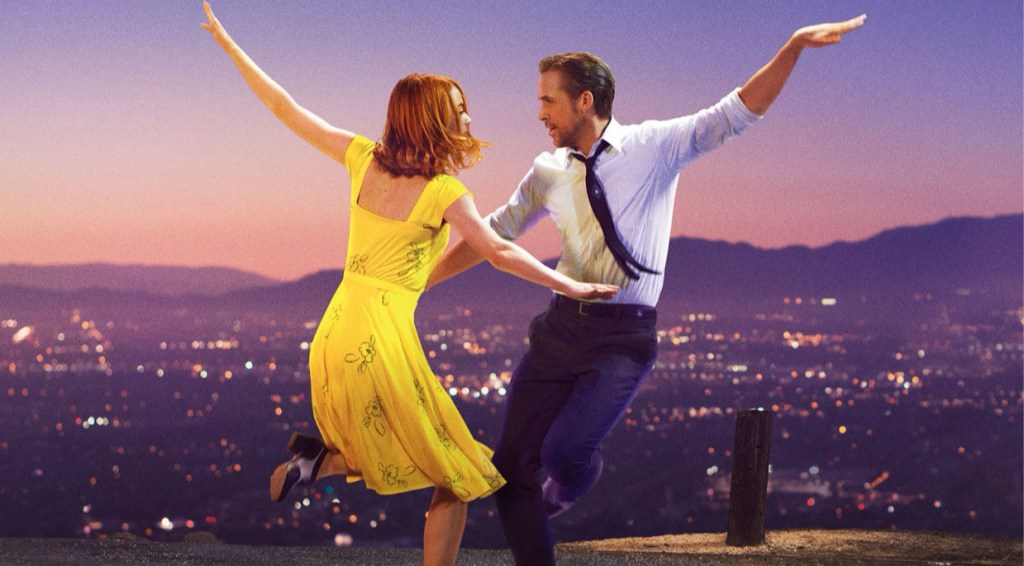
From the opening number, La La Land speaks in bold primary colors—red, yellow, and blue. But these aren’t just aesthetic choices. They’re emotional signals.
- Red = passion and urgency. It appears in moments of deep emotional intensity.
- Yellow = hope, joy, potential. Mia’s yellow dress during her dance with Sebastian reflects the spark of something new.
- Blue = reflective, melancholic. It surrounds Sebastian like a quiet echo of the jazz he plays—beautiful, but full of longing.
Why primary colours? Because they’re pure. Basic. Honest. They reflect the rawness of early ambition and first love. But as the characters grow, the palette softens. The colours mix. The emotions become harder to define—just like their relationship.
The colour changes, because they change.
Jazz Isn’t Just a Soundtrack. It’s the Soul
Jazz isn’t there for style. It’s the heartbeat of the movie. It mirrors the chaos, rhythm, and unpredictability of both life and love.
Jazz thrives on improvisation. There’s no script, no perfect performance. Just listening, reacting, finding your way in the moment. Isn’t that exactly what relationships are? What dreaming is?
Sebastian explains it best in the film—real jazz is about conflict and resolution. And so is this story. It’s about two people trying to stay In tune with each other, even as life pulls them in different directions.
They don’t fail because they stop loving each other. They drift because jazz is hard. Timing is everything. And sometimes you’re just half-beat off.
The Theme Song Tells You Everything—If You’re Listening
“Mia & Sebastian’s Theme” is more than a melody—it’s a timeline.
At the beginning, the notes are close together—warm and intimate. Like two hearts slowly learning to sync. But as the story goes on, the notes strech. There’s more space. More breath. More distance. By the end, it’s still the same song, but it doesn’t feel the same.
Just like them.
And then, in that final dream sequence—the music returns, ruler and more romantic than ever, played over a life they could have had. But it’s only imagined. The notes, like their love, still linger. Just not in the way they once did.
Why This Matters—Even Offscreen
But maybe you’re wondering—why does this matter outside the film?
Because the tools La La Land uses to tell its story—color and music—are the same tools we live with every day.
Colour is emotion. We all move through our own palette of hope (yellow), passion (red), reflectiveness (blue) and everything in between.
And just like in jazz, our lives rarely follow a perfect script. We improvise. We adjust. Sometimes things don’t land where we thought they would. But that doesn’t mean the moment didn’t matter.
La La Land reflects that truth back at us. It shows that beauty doesn’t have to be forever to be real. That some people are in your life not to stay, but to change you.
What La La Land is Really Saying
It’s not about whether they end up together.
It’s about how they helped each other become who they were meant to be.
It’s about love that transforms—even if it doesn’t last.
It’s about the dreams you chase, and the people you lose while chasing them.
That final look across the jazz club says more than words ever could:
Thank you. I remember. I’m better because of you.
So Watch It Again—But Really Watch
Look at the colours. Listen to the space between the piano keys.
Notice how everything shifts, just like it does in real life.
Because La La Land isn’t just a film—it’s a reminder.
Of how we fall in love.
Of how we grow apart.
And of how, sometimes, the most meaningful stories don’t have perfect endings.
Just honest ones.
Bibliography:
Fader, Alex. “La La Land and Color Psychology – Art, Design & Digital Culture.” Addc.blog, 12 Apr. 2022, addc.blog/?p=4917. Accessed 6 June 2025.
“Prime Video: La La Land.” Primevideo.com, 2024, http://www.primevideo.com/detail/La-La-Land/0GQK5UKAMEDC0TSWTLFVZI1Z3Z. Accessed 6 June 2025.
 The Halcyonite
Leave a comment